Do Arizona Rental Properties Need a Pool Fence?
If you own or manage a rental property with a swimming pool in Arizona, pool safety needs to be part of your property management checklist. Arizona has statewide requirements for residential pool barriers, and cities can adopt rules that are equal to or stricter than state law.
Rental properties also have additional considerations because landlords must maintain the property and provide renters with required pool-safety information. For landlords, property managers, real estate investors, and vacation rental owners, the safest approach is to review the pool barrier before a new tenant moves in and confirm that the property meets the rules that apply in its specific city.
Here is what Arizona rental property owners should know.
What Does Arizona Law Require for Residential Pools?
Arizona Revised Statutes § 36-1681 establishes statewide requirements for certain residential swimming pools and other contained bodies of water intended for swimming. The law generally applies to a pool or contained body of water that is at least 18 inches deep at any point and more than eight feet wide at any point.
Pools covered by the statute must have an enclosure surrounding the pool area, subject to exemptions in the law. Arizona’s statewide standards address several important parts of the barrier, including its height, openings, construction, and gates.
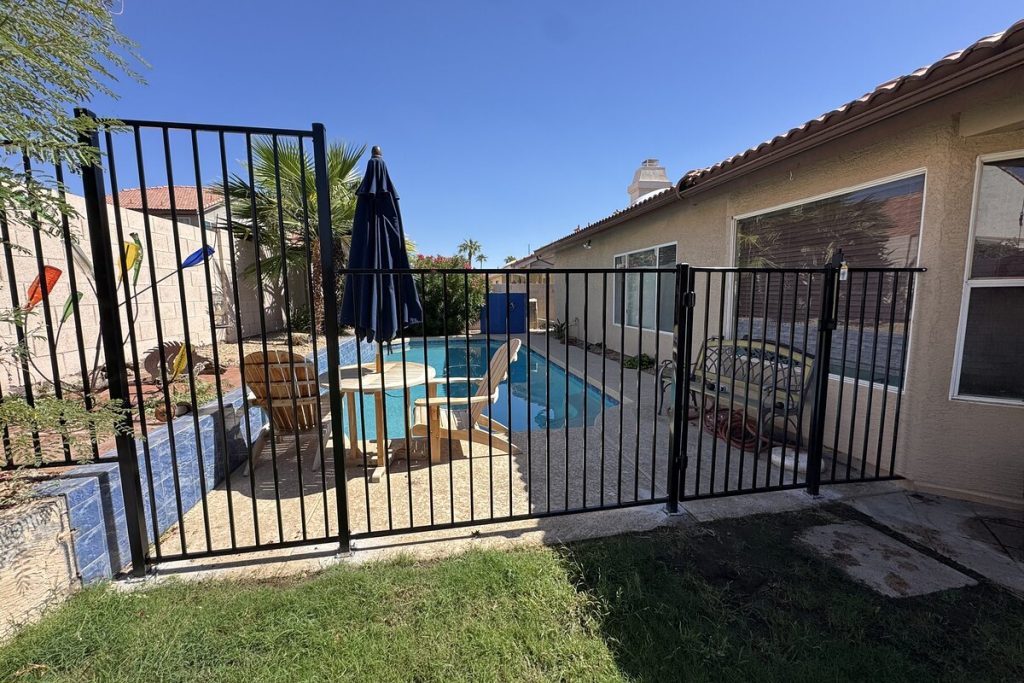
A qualifying barrier generally needs to be at least five feet high. Openings must also be small enough to prevent a four-inch sphere from passing through, and gates have specific requirements, including self-closing and self-latching operation.
These requirements provide a statewide baseline. Individual cities can have their own pool-barrier ordinances, so landlords should also check local pool fence and safety laws.
Are Rental Properties Subject to Pool Fence Requirements?
Rental properties are not automatically exempt simply because the owner does not live at the home. Arizona law specifically addresses homes that are sold, rented, or leased when they have a swimming pool.
When someone enters into an agreement to sell, rent, or lease a dwelling with a qualifying swimming pool or other contained body of water, Arizona law requires that the buyer, renter, or lessee receive an approved notice explaining pool-safety education and responsibilities.
That makes pool safety an important part of preparing an Arizona rental property for occupancy. Landlords should review the physical pool barrier and the documentation provided to tenants.
Does Every Arizona Rental Need a Separate Fence Around the Pool?
The answer becomes more property-specific here. Arizona generally requires qualifying pools to be protected by an enclosure, but that does not always mean every property needs the exact same freestanding fence immediately surrounding the water.
Depending on the property and local regulations, the approved barrier could involve a separate fence around the pool, exterior property fencing, a combination of fencing and walls, portions of the home serving as part of the barrier, or approved doors and gates.
Statutory exemptions also exist, including provisions for older pools and residences where all residents are at least six years old. Local rules can differ and may be stricter.
A landlord should avoid assuming an existing backyard wall or gate automatically meets current requirements. The property’s city, age, pool installation date, and current barrier configuration can all matter.
What Does the City of Phoenix Require?
Phoenix has its own pool-barrier requirements that rental property owners should understand. The City states that swimming pools, spas, and hot tubs must have barriers installed and maintained to separate them from dwellings.
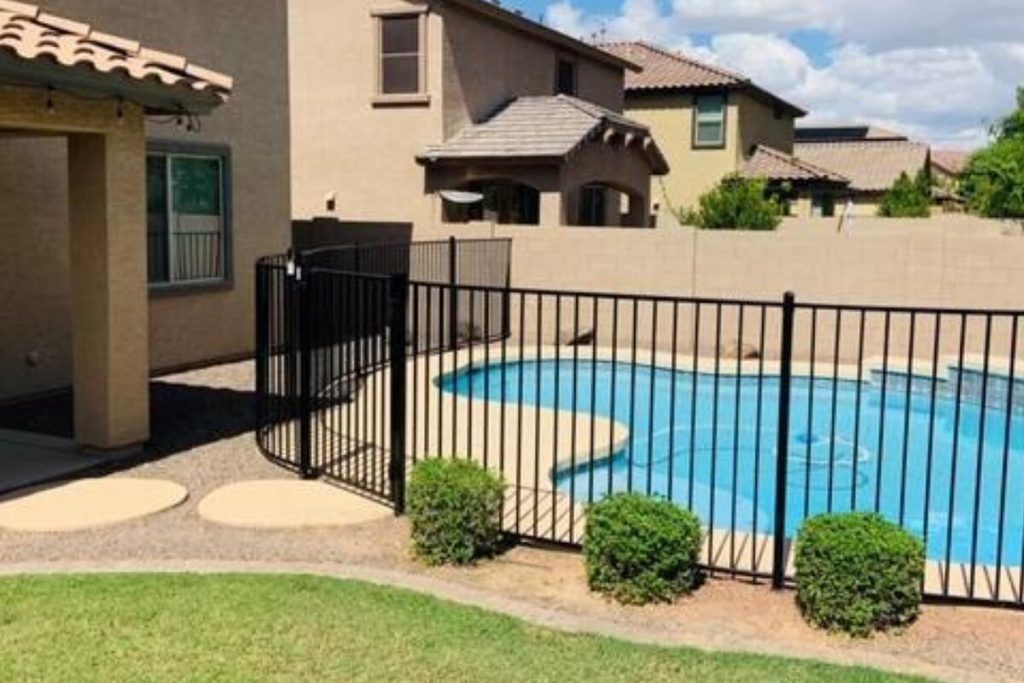
Phoenix requires exterior fencing around pools or properties and says most pools also require an interior barrier, depending in part on when the pool was built. Exterior barrier requirements generally include a non-climbable fence or wall at least five feet high.
Gates must be self-closing and self-latching, and openings in the barrier must generally be less than four inches wide. Phoenix also has specific requirements regarding latch accessibility, which our guide to pool gate height and locking requirements covers in more detail.
For rental property owners in Phoenix, that means the gate’s condition matters as much as the fence itself. A five-foot fence with a gate that stays partially open may still create a serious problem.
When Is an Interior Pool Barrier Required in Phoenix?
Phoenix strengthened its pool-barrier standards in 1990. According to the City’s current guidance, an inner yard barrier is required for new swimming pools permitted after May 4, 1990.
An interior barrier can also become relevant when an existing pool enclosure is altered. For example, changing a door that forms part of the pool barrier can trigger requirements for that new work.
Phoenix identifies different ways to create an approved barrier, including a fence and gate system or using qualifying walls of the residence with compliant doors and windows. This becomes especially important for rental houses where a sliding door or patio door opens directly toward the pool.
Property owners should confirm the configuration rather than assuming the house itself automatically provides a compliant barrier.
What About Apartments and Multifamily Rental Properties?
Owners of apartment buildings and other multifamily properties need to pay particularly close attention to pool separation requirements. The City of Phoenix states that apartments and multifamily dwellings require interior barriers regardless of whether children live at the property.
This makes the pool enclosure a critical part of routine property inspections. Property managers should regularly check fence stability, gate operation, latch function, openings in the barrier, climbable objects near the fence, and changes made during renovations or landscaping.
A minor issue can affect whether the barrier continues to function as intended.
Can the House Be Used as Part of the Pool Barrier?
In some configurations, a wall of the home can form part of the pool enclosure. That creates additional requirements for doors and windows that provide access to the pool area.
Phoenix’s current pool-barrier guidance states that doors leading directly from the dwelling into a yard with a swimming pool must meet specific requirements when they form part of the barrier. These can include self-closing and self-latching operation, as well as requirements for locking or latch mechanisms.
Sliding doors deserve particular attention. Phoenix guidance says sliding doors generally cannot form part of a required barrier unless the self-closing and self-latching mechanism is specifically approved.
For rental homes, owners should review any door that opens toward the pool whenever a tenant moves out. A door may have been replaced, adjusted, or modified since the original barrier was approved.
Pool Gates Are One of the Most Important Areas to Inspect
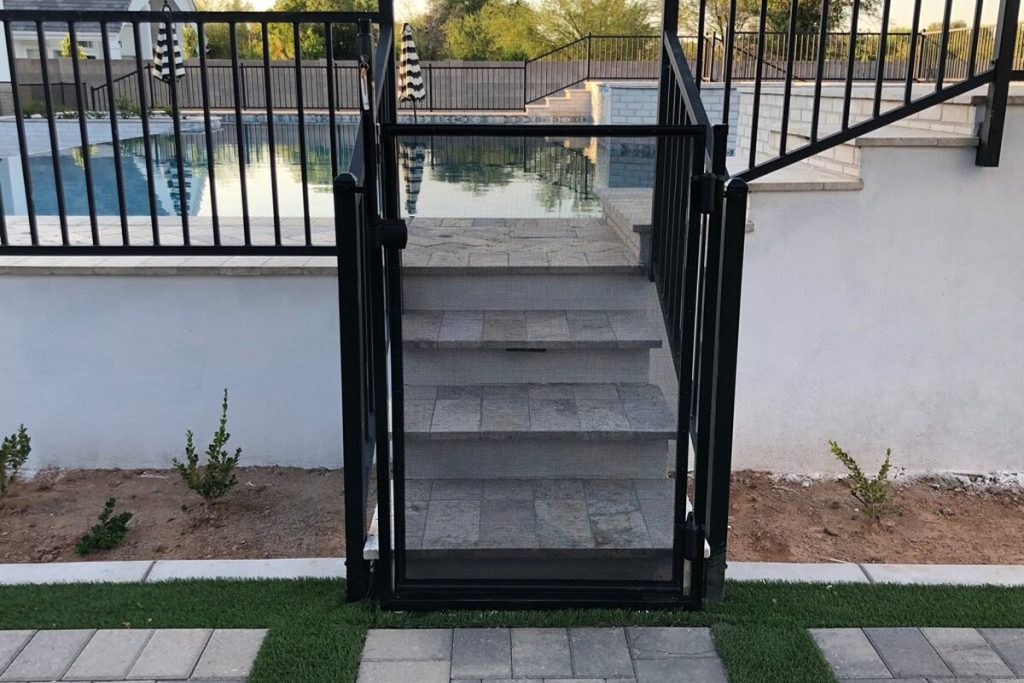
Pool gates experience regular use, sun exposure, movement, and wear. Over time, hinges can loosen, gates can become misaligned, and latches can stop engaging correctly.
A compliant pool gate generally needs to close automatically and latch without someone manually pulling it shut. Arizona law also addresses gate swing direction and requires qualifying gates to open outward away from the pool. Our overview of self-closing pool gates explains how these systems are meant to work.
For landlords, include a simple gate test in every turnover inspection. Open the gate from several positions and let it close on its own, then confirm the latch fully engages each time.
If it sticks, drags, or fails to latch consistently, it deserves attention before the next tenant moves in.
Common Pool Fence Problems at Arizona Rental Properties
Arizona weather can be hard on outdoor equipment. Extreme heat, sun exposure, dust, and monsoon conditions can affect fencing, hinges, anchors, and gates over time, which makes routine pool fence maintenance important for rental properties.
Common issues include gates that no longer close automatically, loose fence posts, damaged mesh, bent or misaligned gates, worn hinges, increased gaps beneath fencing, and latches that no longer engage consistently.
Rental properties can also develop problems simply because different tenants use the backyard differently. Patio furniture, storage containers, planters, grills, and other objects may be placed near the fence.
Objects positioned close to a barrier can potentially create a way for a child to climb over it. Pool safety inspections should therefore include the surrounding area, not just the fence itself.
Be Careful With Pet Doors and Property Modifications
Pet doors can create another issue when the house forms part of the pool barrier. Phoenix guidance states that doggie doors are not permitted when the house wall is being used as part of the approved pool barrier.
Landlords should also watch for other modifications made between inspections, such as replacement patio doors, new gates, modified fence sections, added landscaping, new outdoor structures, or changed locks and latches.
Even a well-intentioned improvement can affect the existing pool-barrier system. Before major backyard renovations or door replacements, property owners should determine whether the work affects the approved barrier.
Are Removable Pool Fences a Good Option for Rental Properties?
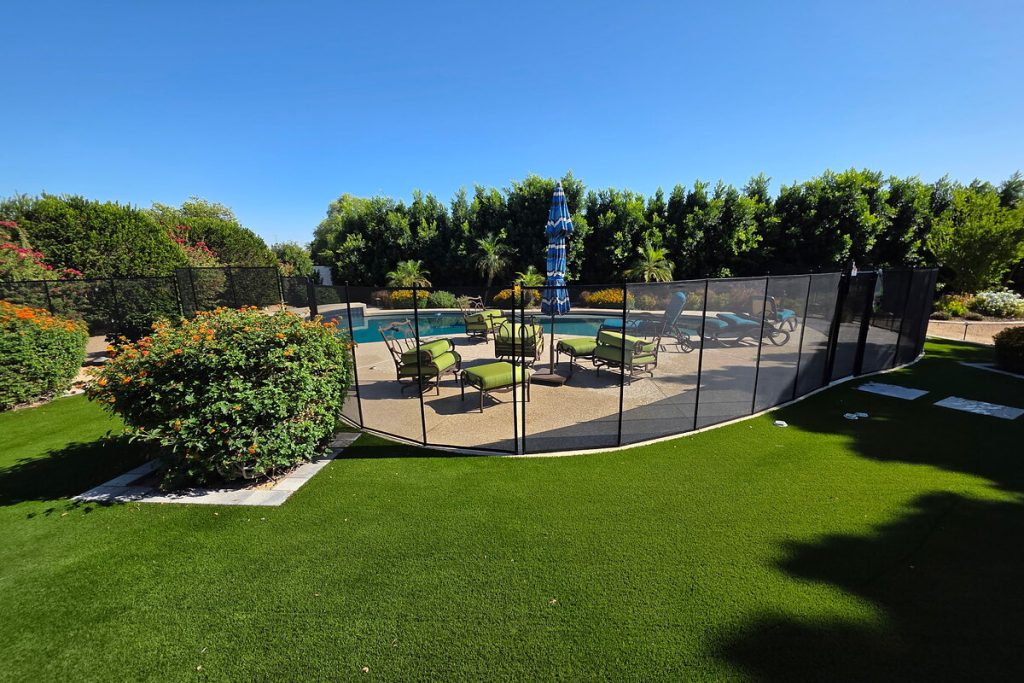
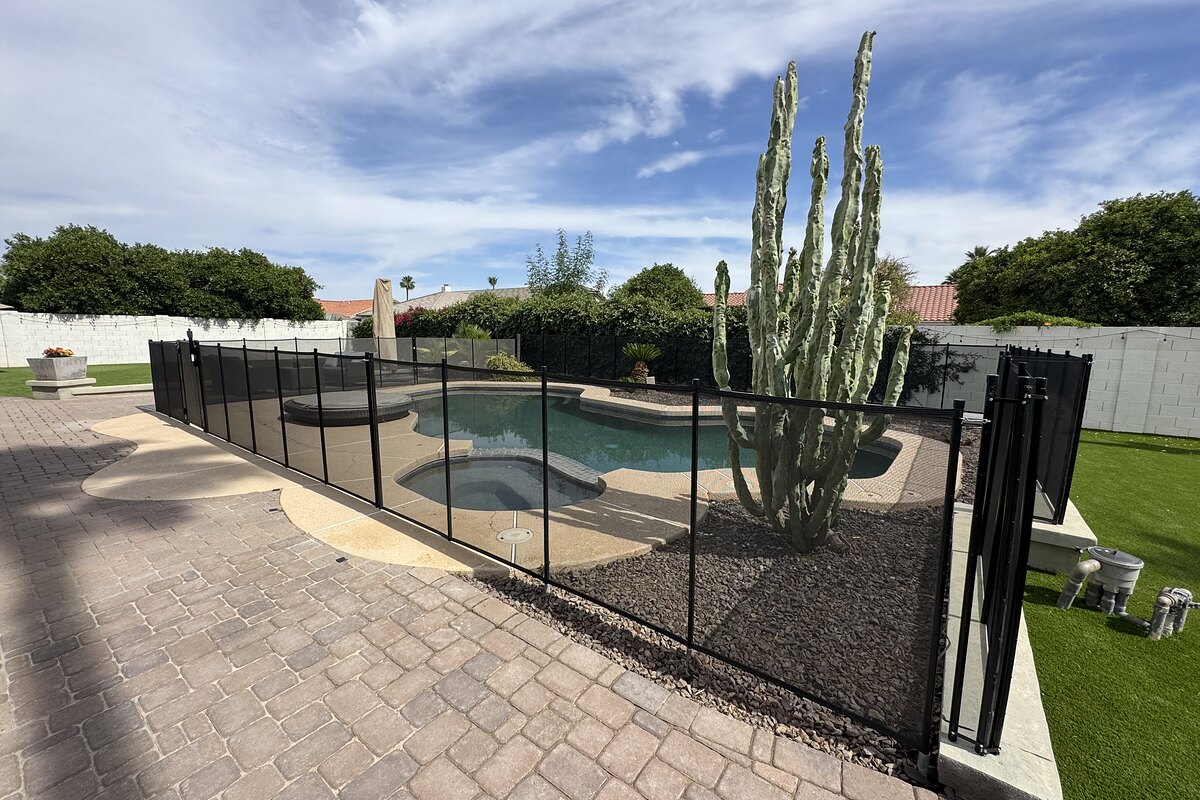
Removable mesh pool fencing can be a practical option for many Arizona homes because it creates a dedicated barrier around the immediate pool area. It can be especially useful when a rental property’s backyard layout makes it easy to access the pool directly from the home or patio.
A properly designed removable pool fence can preserve visibility while helping create separation between the living space and pool. Common applications include single-family rental homes, vacation rentals, homes with large patios, properties with sliding doors facing the pool, and homes where an older barrier needs updating.
The important distinction is that a removable or temporary-looking barrier does not automatically satisfy local building requirements. Phoenix’s current guidance notes that temporary fences and alarms do not replace the code-required automatic-closing physical barrier, though they can provide additional layers of protection.
Always evaluate fence design and installation against the requirements that apply to the property.
Short-Term Rentals Should Receive Extra Attention
Vacation rentals create a different type of pool-safety environment because occupants change frequently. Guests may be unfamiliar with the backyard, pool gates, locks, doors, or surrounding layout.
That makes a clearly separated pool area particularly valuable. Short-term rental owners should consider inspecting the pool barrier before peak rental periods, after landscaping work, after repairs, when a gate has been adjusted, or whenever renovations affect doors, fences, or patios.
Pool-barrier inspection should become part of the property’s normal maintenance process rather than something checked only when a problem appears.
Arizona Landlords Must Provide Pool Safety Information
Physical barriers are only part of Arizona’s requirements. State law requires a person entering into an agreement to rent or lease a dwelling with a qualifying swimming pool to provide the renter or lessee with an approved pool-safety notice.
Landlords should include current pool-safety information with their rental documentation. Owners using property management companies should also confirm who is responsible for providing this notice and documenting that it was supplied.
A Practical Pool Fence Checklist for Landlords
Before a tenant moves into an Arizona rental property with a pool, inspect the entire barrier system.
Check that:
- The fence or barrier meets applicable height requirements.
- Openings are within allowable limits.
- There are no excessive gaps beneath the barrier.
- Gates close on their own.
- Gates latch automatically.
- Gate hardware operates smoothly.
- Gate swing direction meets applicable requirements.
- Fence posts and anchors remain secure.
- Furniture and other climbable objects are away from the barrier.
- Doors leading to the pool area operate correctly.
- Sliding doors meet applicable requirements.
- Previous tenant modifications have not changed the barrier.
- Required pool-safety information is ready for the new tenant.
Owners should also document repairs and inspections in their regular property-maintenance records.
When Should an Existing Pool Fence Be Replaced?
Some pool barriers can be repaired, while others reach the point where replacement becomes the better long-term option.
Consider replacing the fence or gate system when multiple sections are loose or damaged, the gate repeatedly fails to close, the latch regularly becomes misaligned, the fence no longer fits the current backyard layout, repairs become frequent, or renovations have changed access to the pool.
A new fence can also be an opportunity to improve the backyard layout. Pool fencing does not have to make the property feel closed off.
A well-planned system can maintain visibility and usable patio space while creating a more clearly defined pool area.
Who Is Responsible for Maintaining the Pool Barrier?
Rental property owners should treat pool-barrier maintenance as part of property maintenance. Tenants can and should report damage, but landlords and property managers should not rely entirely on tenants to recognize a failing latch, incorrect gate operation, or other compliance issue.
Include the pool barrier in periodic property inspections and establish a process for tenants to report damage immediately. If the fence, gate, or access point is damaged, address the problem promptly.
Frequently Asked Questions
Does Arizona require a fence around a rental property pool?
Arizona requires qualifying residential pools to have an enclosure, subject to statutory exemptions and local ordinances. Rental property owners should confirm both state and municipal requirements.
How tall does a pool fence need to be in Arizona?
Arizona’s statewide standard generally requires a barrier at least five feet high. Phoenix also uses a five-foot requirement for applicable pool barriers.
Does a pool gate have to be self-closing?
Qualifying enclosure gates generally must be self-closing and self-latching.
Can the house count as part of the pool barrier?
Yes, in some configurations. When the home forms part of the barrier, doors and windows leading to the pool area may need to meet additional requirements.
Are removable pool fences allowed?
Many Arizona homes use removable mesh pool fencing, but the specific system and installation must comply with applicable local requirements. Phoenix also makes clear that temporary fencing does not replace its required physical barrier.
Do landlords have to provide pool-safety information?
Yes. Arizona law requires an approved pool-safety notice when entering into an agreement to rent or lease a dwelling with a qualifying pool.
Make Pool Safety Part of Managing Your Arizona Rental
Owning a rental property with a swimming pool comes with additional responsibilities. Arizona establishes statewide pool-enclosure requirements, while cities such as Phoenix have their own detailed barrier standards.
The requirements that apply to an individual property can depend on its location, property type, age, pool construction date, and barrier configuration. For landlords, the practical approach is straightforward: inspect the pool barrier before every new tenancy, keep gates and latches working correctly, watch for changes that affect the enclosure, and verify local requirements whenever the property is renovated.
A pool fence needs ongoing attention. Arizona heat, frequent use, landscaping, and property modifications can all affect a barrier over time.
Need a Pool Fence for an Arizona Rental Property?
If you own or manage a rental property in the Phoenix area and need to install, replace, or update a pool fence, Arizona Pool Fence can help you evaluate options for your property.
Whether you are preparing a home for new tenants, updating an older pool area, or adding a dedicated barrier between the house and pool, the right fence can improve backyard safety and usability.
Visit www.poolfencesinphoenix.com to learn more or request an estimate for your Arizona property.